August Edition of the Crypto Altruists Newsletter
👋Hello, Crypto Altruists!
Web3 has never been short on theories about how people should organize. Testing one takes a place, a few hundred people, and time.
DWeb Camp ran its latest edition in Germany last month, Valley of the Commons opens in the Austrian Alps later this August for a full month, and popup villages now run year-round across four continents. And two of the longer-running experiments reported back this month... 👀
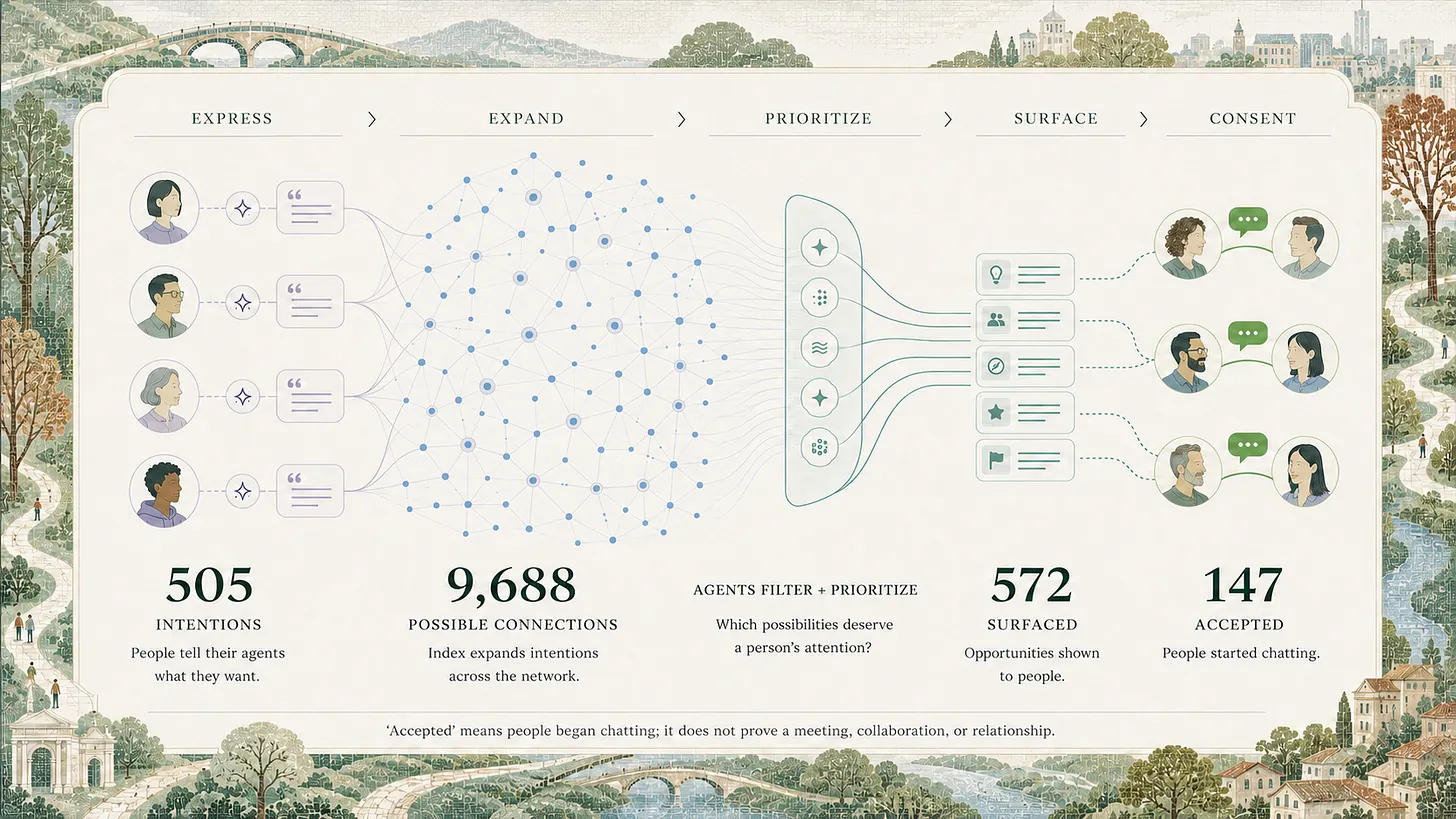
Edge City announced its tenth village since 2023: three weeks in Goa, India, this October, timed so residents can roll into Devcon Mumbai. They also published findings from the Agent Village experiment we flagged in May, where every attendee at their California village got a personal AI agent.
Over four weeks, the agents introduced people to each other, helped allocate a shared treasury, and argued their way through a constitution. The most striking result: two-thirds of the introductions they made were between people in different social circles. At most gatherings, people meet a handful of others early on and stay there, which means the value of putting 500 interesting people in one place mostly goes unrealized. That's a coordination problem nobody has solved with name tags and icebreakers.
The Network School was built on the opposite premise. Rather than showing up for a month and leaving, Balaji Srinivasan set up a permanent campus in Malaysia in 2024, as a physical prototype of his network state thesis, where aligned communities cluster in one place and eventually seek recognition. In July, after weeks of political controversy, local authorities revoked its business licence. Within hours, Srinivasan had signed with Kazakhstan.
One Malaysian founder's thread on why it happened got over 120K views.
🇲🇾 I'm Malaysian, so watching @balajis's Network School (@ns) get its license pulled in Johor isn't abstract for me
— Aaron Teng 安伦 🐧 (@AaronTeng) July 21, 2026
The concept was good. It brought real energy into a near-empty city. It still got shut down. If you're a Western founder looking at Asia, don't read the headline.… https://t.co/F1HQmnUQab pic.twitter.com/GZh6NSYFMx
Exit is the network state's founding mechanism: when a jurisdiction stops serving you, leave and take your capital with you. But leaving requires somewhere willing to have you, which puts the network state right back in the hands of the nation states it was built to route around. The immediate trigger was pointed: social media allegations that the campus was hosting Israeli nationals in a country with no diplomatic ties to Israel set off an immigration probe that snowballed into the licence review, briefly pulling in the US State Department. But the deeper pattern predates that spark. The campus had spent two years marketing itself as an island near Singapore rather than a project in Malaysia, so when the accusations came, almost nobody locally had a reason to defend it.
At the same time, this saga has reheated a longstanding critique of the network-state project itself. Critics have traced "exit" politics back to accelerationist and neoreactionary thinkers like Nick Land and Curtis Yarvin, whose "Dark Enlightenment" argues democracy is the obstacle to progress and should give way to rule by a self-selected elite. Some go even further: journalist Gil Duran, who writes The Nerd Reich, calls the vision "tech fascism" outright, pointing to a 2023 talk where Srinivasan described tech-loyal "Gray" tribes policing San Francisco. Srinivasan rejects the label, and even sympathetic observers call the scene a mixed bag, but the skepticism isn't limited to outsiders. At a moment when democratic backsliding is a very real worry worldwide, a growing chorus of critics, including many from inside Web3 itself, argue network states aren't a new coordination mechanism so much as a rebrand for a new, tech-driven oligarchy.
Whether we agree with the approaches or not, there's something fascinating about watching coordination get worked out in person instead of argued about online. Each village, camp, and campus is a small preview of how we might organize ourselves at the community level. Or a decent argument for why we shouldn't.
Here's what we've been paying attention to this month. 👇
🌱 Featured: Ukraine's Independence Day
On August 24, Ukraine marks 35 years since it declared independence from the Soviet Union. It will spend this one, like the last four, defending the thing it is celebrating.
Attention has moved on, though, and money has followed. US aid programs have been cut back, donor governments are shifting budgets toward defense, and the Global Fund is facing shortfalls. But needs on the ground have gone the other way entirely.
Kyiv 05.08.2026
— Maksym Zalevskyi GEN Ukraine #Octant (@RodovidMe) August 5, 2026
Never stop speak about Ukraine 🇺🇦
Not only Palestyne.#StandWithUkraine pic.twitter.com/Pk4x11aAQ2
That distance between what a crisis needs at the start and what it needs in year five is something we keep running into.
It's there in Ivan's story, our first video episode, where recovery after he lost his sight in 2022 took four weeks of training, a month of follow-up at home, and a program that has to exist again next year for the next twenty veterans. And it's there in what Ukraine taught crypto philanthropy, where a wallet address on Twitter raised $100 million in weeks, yet almost nothing built in that rush was designed to still be running now.
We also did an episode with Max, who runs an ecovillage network in Ukraine. 👇

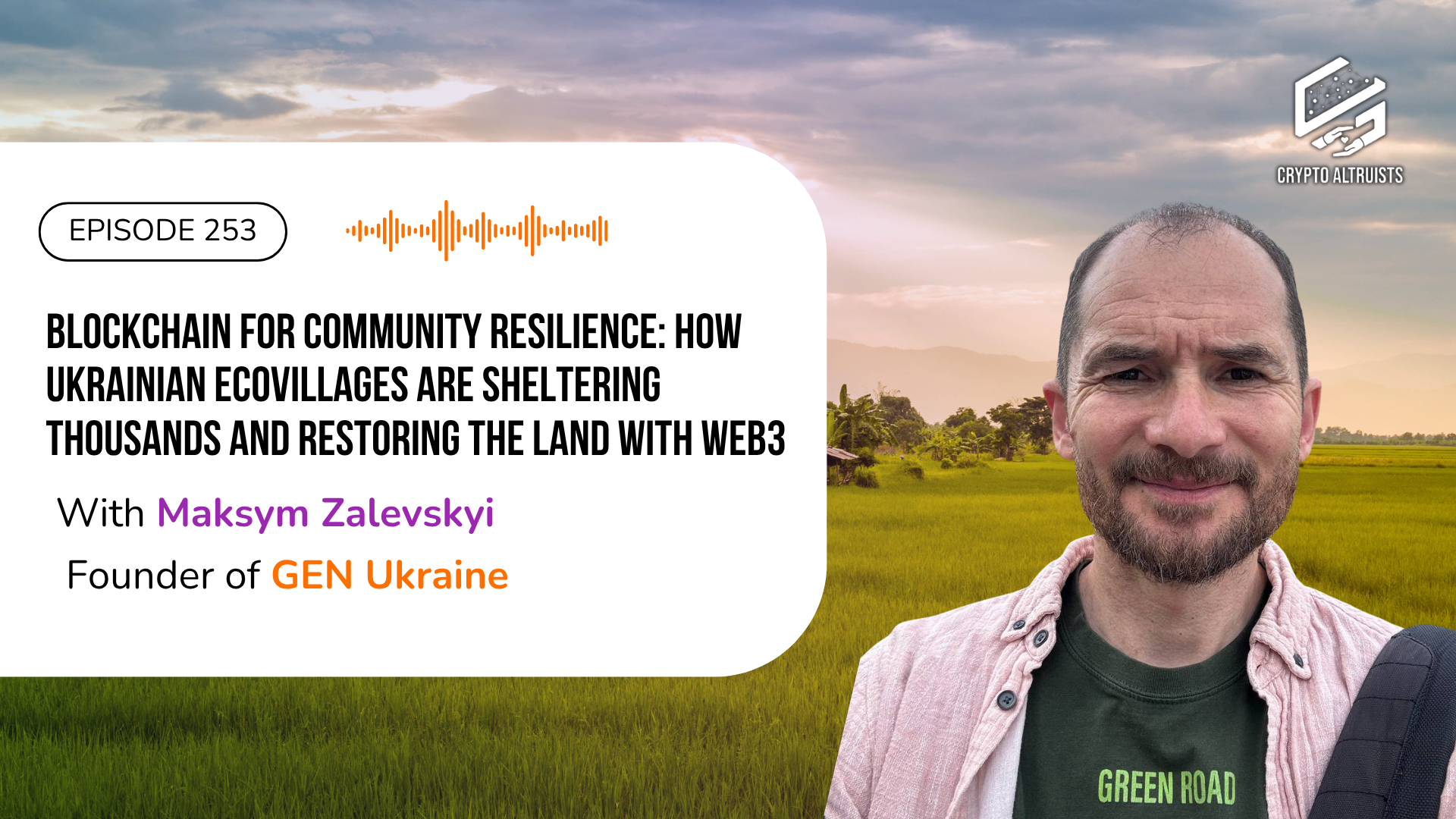
Crypto has proved it can show up fast. Staying is the harder part, and that's where we'd like to help. So, we're planning a campaign to support the work in Ukraine over a longer horizon, and we're still shaping it, which is where you come in.
If you have a story from there, if you're building for recurring giving or multi-year funding, or if you have views on what long-term support for Ukraine requires, write to us at partnerships@cryptoaltruists.com or schedule a quick chat with us. 💛💙
Ecosystem developments 🚀
- POAP Winds Down After Five Years of Minting Millions of Event Collectibles: The team shared that crypto's funding cycles made it hard to build a sustainable business without compromising what made POAP meaningful in the first place.
- Ethereum Foundation Publishes a Plain-Language Primer for Governments: The non-technical guide walks policymakers through how Ethereum works and how it differs from other blockchains on resilience, client diversity, and who can change the rules.
- Karma Launches an AI Agent That Researches Nonprofits for Donor Advisors: The tool verifies charity status, pulls the latest 990 filings, checks state registries, and scans news coverage, then ranks the field and proposes three organizations that match a client's cause, geography, and grant size.
- Gitcoin Publishes Honest Notes From Its Reboot Meetings: With roughly $16M left in the treasury, the transition stewards are working through what went wrong in the DAO era and testing a trust graph system that could eventually let stewards outvote the founder.
- Octant Cuts Its Matching Pool and Shifts Toward Thematic Rounds: After 13 epochs and 5,273 ETH in grants, Golem Foundation is stopping new contributions to the matching pool and moving toward focused epochs and direct giving. The news landed shortly before Octant announced Epoch 13, centered on privacy.
- Mercy Corps Ventures Shares Results From Its Embedded Climate Insurance Pilot in Kenya: Rainfall data triggered smart contracts that automatically reduced loan balances when heavy rain hit, cutting settlement from 30 days to one. Of the 203 traders reached, 76% were women and over half had been denied a loan before.
- Ethereum Mainnet Turned 11 in July: Eleven years since launch, and the network has never gone down. The birthday post drew warm messages from across the ecosystem, from Base and Uniswap to MetaMask and Arbitrum.
- Germany Runs Quadratic Voting at the Federal Level: Nearly 28,000 citizens submitted what frustrates them most about dealing with government, and an AI-assisted process condensed those into 13 challenges that the whole country then voted on to decide which ones federal ministries tackle first.
- Ethereum Foundation's Privacy Task Force Spins Out as EthSystems: After a year inside the Ethereum Foundation building confidential transaction tools for banks and regulators, the team has launched as an independent for-profit company, adding to the wave of groups leaving the Foundation to continue their work elsewhere.
- UNDP and Stellar Extend Their Partnership to Scale Digital Payments Across Country Offices: After pilots in Haiti, Syria, Kenya, Guatemala, and The Gambia, the next phase focuses on making blockchain payments a standing capability rather than a series of experiments. In Aleppo, distribution costs dropped from roughly 10% of funds to 2%.
- Vitalik Buterin Says Pseudonymity Is Dead in 2026: Welcoming Signal's plan to allow signup without a phone number, he argued that AI can now piece together identity from message timing, contact patterns, and behavior alone, so encryption without unlinkability no longer protects anyone.
Crypto Altruists content & updates 💚
- 🎙️ Crypto Altruists Episode 258: Football & Financial Inclusion: All In For Sport on their work with Sarreya in Somaliland, where a grant payment that took six months to arrive turned into a test of whether Web3 can move money and shift power at the same time.
- 🎙️ Crypto Altruists Episode 259: Navigating the New Impact Landscape: Inès d'Haultfoeuille of Egregor on the "missing middle" where proven organizations stall out before they can scale, and how to tell useful technology from noise when funding is tight.
- ✍️ What Happened to Crypto Carbon? Blockchain and Carbon Markets in 2026: A freshly updated look at how tokenized carbon went from hype to infrastructure, with most of the first wave gone and the registries that once banned tokenization now building onchain themselves.
- 🎙️ Crypto Altruists Episode 260: From PPE to Patient Access: Nurse and tech builder Sharonda D. on the new Crypto Community Fund for Healthcare Access, and why tools for health workers need to be built with them rather than for them.
- 🎙️ Crypto Altruists Episode 262: Co-ops and DAOs: D.G. Safeer Hopton has spent 50 years in the cooperative movement, and he makes the case that DAOs are wrestling with governance problems co-ops solved decades ago.
- ✍️ A Greener Landscape: Blockchain and Land Protection: A refreshed look at tamper-proof land registries, nature credits, and community land DAOs, from a Nigerian startup mapping property titles to Indigenous-led jaguar credits in the Ecuadorian Amazon.
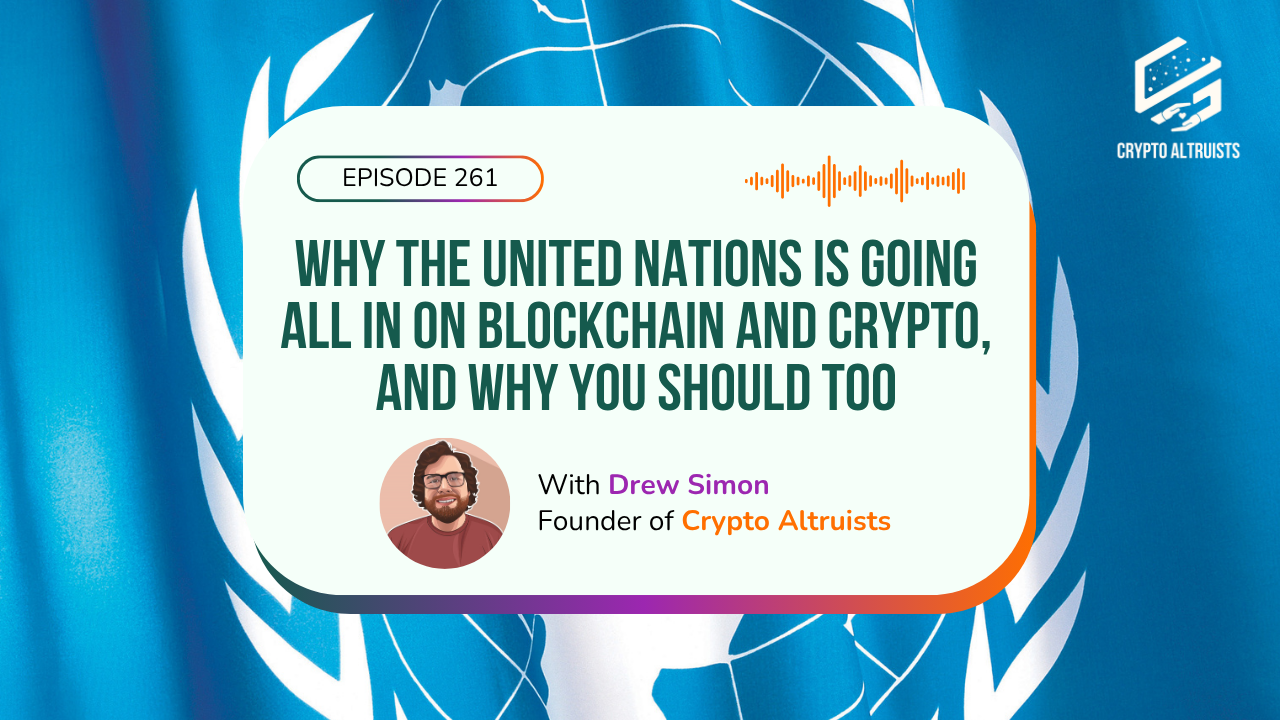
- 🎙️ Crypto Altruists Episode 261: Why the UN Is Going All In on Blockchain: A solo episode walking through what UNICEF, WFP, UNHCR, and UNDP are actually building, and what nonprofits can take from the most cautious institution on earth deciding these tools are worth using.
Insightful resources 📖
- Ten Mathematical Results Generated by an AI Model: Ten long-standing open problems resolved or advanced, plus a thoughtful section on how attribution should work when the arguments come from a machine.
- The Case for "Reverse Alignment": Glen Weyl and co-authors argue that aligning AI to human values is only half the job, and the other half, redesigning institutions so societies can absorb it, gets a tiny fraction of the funding.
- A Conversation on Imagining Futures Worth Building: Juan Benet and Foresight Institute's Allison Duettmann on why optimistic visions of the future are a precondition for creating them.
🌟 Project highlight: Grassroots Economics
Applications just opened for what Will Ruddick is calling the first hackathon focused on commitment pooling, which gave us a good excuse to spotlight the organization that has spent sixteen years developing it.
Grassroots Economics starts from a simple observation: communities are rarely poor in resources. They're poor in national currency, and that's a different problem with a different solution.
Commitment pooling is their answer. Rather than waiting for money to arrive from outside, people put what they can already offer into a shared pool. A carpenter commits future work, a farmer commits future produce, a school commits future places.
Those commitments are issued as Community Asset Vouchers, which circulate as a medium of exchange within the community and can be redeemed for the goods and services they represent.
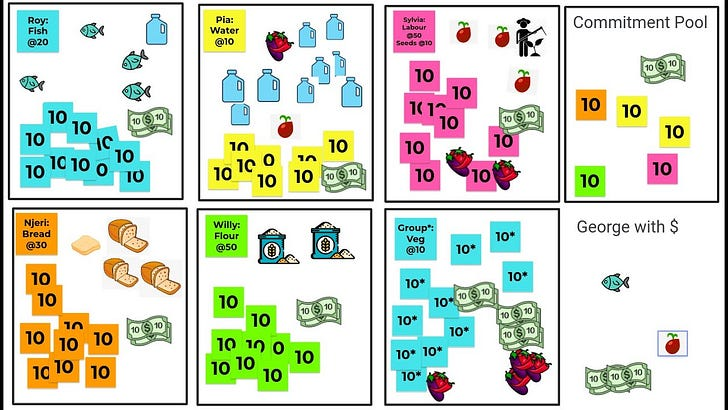
It all runs through Sarafu Network, built on Celo, and what circulates is the community's own capacity rather than shillings it doesn't have.
At its peak, the network reached tens of thousands of users across Kenyan villages and informal settlements, moving the equivalent of hundreds of thousands of dollars in local trade, almost all of it spread by word of mouth.
Will explained how all of it works on Episode 241, alongside Coleen Chase of The Solar Foundation.
 Will Ruddick
💡 Bring web3 into your nonprofit's mission
Crypto Altruists works with nonprofits, foundations, and impact teams that want to understand if blockchain is useful for their work. We help with things like crypto donations, transparency tools, and practical web3 experiments.
Our consulting and workshops are hands-on, clear, and tailored to your reality. Book a call if you want to explore what makes sense for your work. 🤝
💸 Send a tip in ETH: cryptoaltruists.eth
🤝 Send a tip in BTC, SOL, and other tokens
☕ Buy us a coffee
📬 Stay connected
Subscribe to get Crypto Altruists content delivered directly to your inbox every month. If you'd like to share any feedback or ideas, you can always reach us at partnerships@cryptoaltruists.com & via the social media platforms below!
Twitter | LinkedIn | Bluesky | Instagram | YouTube | Farcaster |Podcast
See you in the next edition! 💚