June Edition of the Crypto Altruists Newsletter
👋Hello, Crypto Altruists!
There's something we keep noticing... The blockchain for good conversation is finding its way into rooms it wasn't in before.
Paris this month was a good example. UNDP launched its Blockchain Advisory Group at Proof of Talk, gathering 26 blockchain organizations at the Louvre Palace, and then took the same conversation to Sciences Po the next day with governments and policymakers in the room.
We were sad to miss it. These are exactly the conversations that excite us.
 Nico Poggi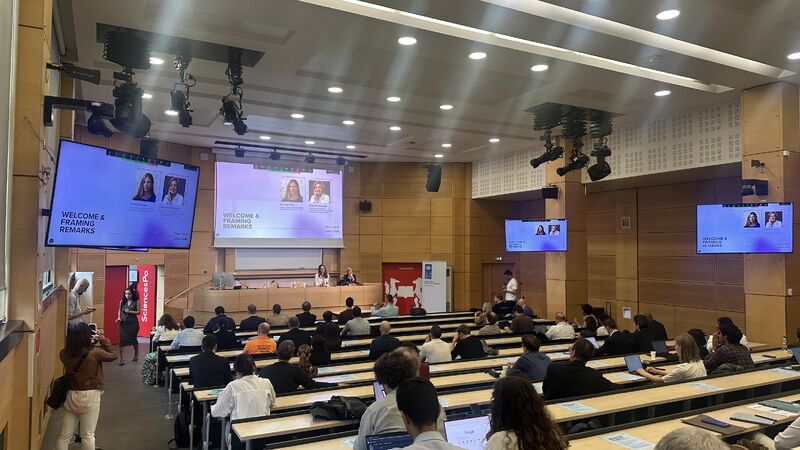
Reading the recaps, what strikes us is that a few years ago, these conversations were still about convincing people this was worth taking seriously. In Paris, that argument had already been made. The room was working through more tangible questions: what governments actually need to adopt this responsibly, how you build systems people can trust, what credible implementation looks like when it moves beyond pilots. 🌍
One number that puts it in context: WFP's Building Blocks blockchain has already helped avoid more than $250M in duplicate aid payments. Cheers to more of that!
Here's what we've been paying attention to this month. 👇
🌱 Featured: Our guide to DeSci is live!
The traditional science funding system is having a bad year.
In the US, NIH grant rates have cratered, thousands of grants got cancelled mid-cycle, and three in four scientists surveyed said they were considering leaving the country. For many researchers, 2025 was the year the system stopped feeling fixable from within.
We've been following decentralized science (DeSci) for a while (before it was a bubble and even after the bubble popped). But still, this felt like the right moment to write something comprehensive and honest about where things stand now.
There's a lot more where that came from, and a lot that still hasn't been proved. The guide covers all of it: the origins, the mechanisms, the projects worth following, and the honest questions the space still hasn't answered.
💡 June impact spotlight
Ecosystem developments 🚀
- 67 Million Americans Now Hold Crypto, New Report Finds: The National Crypto Association's second annual survey of 10,000 US holders maps the changing face of crypto adoption, how people are using it, and what's still holding others back.
- Stellar to Power Bermuda's Plan to Become the World's First Fully Onchain Economy: Bermuda is moving key payment and financial services onto the Stellar network, with residents able to receive wages, pay merchants, and settle government fees through digital wallets.
- Mercy Corps Ventures Pilots Stablecoin Cash Transfers for Vulnerable Women in Rural Haiti: The pilot will disburse $80,000 in USDC to 200 rural women through a digital wallet built for low-connectivity environments, as an alternative to physical cash distribution in a context where carrying money has become dangerous.
- Switzerland Launches First Government Blockchain Project to Reward Ecological Conservation: A Swiss municipality launched BIDI, a system that rewards residents with digital vouchers for conservation work like meadow restoration and invasive species removal.
- Vitalik Buterin Shares His Personal Take on the Ethereum Foundation's Direction: A candid thread on why the EF is choosing to become smaller and more opinionated, doubling down on censorship resistance, privacy, and open source rather than competing on speed and scale.
- Gitcoin Eyes Pivot Toward AI Resilience as Its Next Major Focus: Kevin Owocki published a community post arguing that the AI transition is the next major public goods challenge, and that Gitcoin's coordination infrastructure, built over 8 years for Ethereum, is ready to be applied more broadly.
- Funding the Commons Releases Report on AI-Driven Governance Experiment: Six communities within the Frontier Tower in San Francisco each got seed funding and freedom to allocate it, leading to a shared treasury that floor leads and an AI agent govern together.
- European Commission Opens Public Consultation on MiCA Crypto Regulation: The EU is reviewing whether its crypto regulatory framework fits the current market landscape and is inviting public feedback until August 31.
- Vitalik Buterin Is Writing a Sci-Fi Novel on Decentralized Governance: Ethereum's co-founder is exploring governance questions through fiction, a format that might reach people whitepapers never will.
Crypto Altruists content & updates 💚
- 📊 Infographic: 5 Stages to Secure Your Crypto: A beginner-friendly breakdown of wallets, seed phrases, and scam spotting
- 🎙️ Crypto Altruists Episode 251: From Savings Circles to Smart Contracts: NEDA Labs on building digital infrastructure for savings groups in Tanzania, including a Tanzanian shilling stablecoin, with founders whose own mothers are savings circle members.
- ✍️ The Impact Sector Has the Most to Prove and the Most to Gain from Web3: Nonprofits raise $3.7 trillion a year on infrastructure that was never built for them. The case for why that gap is finally closeable.
- 🎙️ Crypto Altruists Episode 252: A New Model for Public Goods Funding: Paul Glavin of Gardens on conviction voting and streaming funds, two mechanisms trying to fix how communities fund public goods.
- 🎙️ Crypto Altruists Episode 253: Blockchain for Community Resilience: Maksym Zalevskyi of GEN Ukraine on how 60+ ecovillages have sheltered over 3,000 displaced Ukrainians while using Web3 tools to track solar energy and land regeneration.
- 🎙️ Crypto Altruists Episode 254: Memes with Meaning: Alison of Buddies for Paws on how the BONK memecoin community raised nearly $600K for animal welfare, with every donation matched 100%, and why storytelling is at the heart of it all.
Insightful resources 📖
- This Week in Crypto Philanthropy: Founders Pledge on How Entrepreneurs Think About Giving: Travers Oliver of Founders Pledge on how high-net-worth donors approach philanthropy and why crypto is becoming part of modern giving strategies.
- Coordination Is the New Bottleneck: Gitcoin's Kevin Owocki argues that capital and AI capability are no longer what's limiting progress. The missing piece is infrastructure for legitimate coordination across plural agents, communities, and time horizons.
- Funding That Flows: Why Grants Should Behave More Like Rivers Than Calendars: A sharp argument for continuous, community-directed funding over time-gated grant rounds, and why the current batch model rewards good applications over good ideas.
- A Path Through AI Overwhelm: Four grounding questions to help nonprofit leaders start building an AI strategy without getting lost in the hype.
🌟 Project highlight: GoodDollar
This isn't our first time spotlighting GoodDollar, and it probably won't be our last.
Since 2020, the protocol has been delivering daily universal basic income (UBI) through a phone app. Nearly a million people across 180+ countries claim G$ tokens every day, with no founder allocation, no private sale, and every token minted going directly to UBI.
Now, GoodDollar is in the middle of something new. After a nine-week community governance redesign called CoGov, GoodDAO 2.0 emerged with a new bicameral structure. One of its two bodies is called the House of Alignment.
Aligned projects stake G$, receive monthly distributions, and redistribute them into their own communities, creating economic activity that flows back into the protocol. The ambition has also expanded beyond UBI distribution. GoodDollar wants to build a full economy on top of the infrastructure it's spent years laying down, with mission-aligned projects as the connective tissue.
The four proposed inaugural members are Gardens, Green Goods, ReFi DAO, and Textile.
GoodBuilders Season 3 just wrapped too, with 9 teams spending 31M G$ on bill payments, savings circles, food rescue, and more over three months. Season 4 is on the way.
And there's something we're cooking up with GoodDollar that we're not quite ready to share yet. More soon. 🗳️
Something special is cooking... 👀🍳
— Crypto Altruists (@Crypto_Altruism) June 3, 2026
Just wrapped an amazing chat with @meriiifdez & Rael of @gooddollarorg and @GravenPrest of @flowstatecoop that we can't wait to share 🎙️
Stay tuned... this one's going to be fun 💚 pic.twitter.com/yWFafrESem
💡 Bring web3 into your nonprofit's mission
Crypto Altruists works with nonprofits, foundations, and impact teams that want to understand if blockchain is useful for their work. We help with things like crypto donations, transparency tools, and practical web3 experiments.
Our consulting and workshops are hands-on, clear, and tailored to your reality. Book a call if you want to explore what makes sense for your work. 🤝
💸 Send a tip in ETH: cryptoaltruists.eth
🤝 Send a tip in BTC, SOL, and other tokens
☕ Buy us a coffee
📬 Stay connected
Subscribe to get Crypto Altruists content delivered directly to your inbox every month. If you'd like to share any feedback or ideas, you can always reach us at partnerships@cryptoaltruists.com & via the social media platforms below!
Twitter | LinkedIn | Bluesky | Instagram | YouTube | Farcaster |Podcast
See you in the next edition! 💚